
CN23 for dropshipping: your non-EU and overseas shipments in your name

Selling a part to a customer in Switzerland, the United Kingdom or Réunion also means paperwork. The parcel must travel with a customs declaration, the CN23, and a commercial invoice. In dropshipping, one question comes up quickly: in whose name?
At JDM Distribution, yours. You enter your selling prices, we prepare the documents and the parcel leaves under your name.
What is a CN23?
The CN23 is the customs declaration that goes with a parcel sent outside the EU VAT area. It says who is sending, to whom, and what the parcel contains: the description of each item, its quantity, weight, value, customs code and country of origin. It also states the nature of the shipment, here a sale of goods.
Customs in the destination country use it to check the parcel and calculate duties and taxes. A commercial invoice goes with it in the pouch attached to the parcel.
You may have come across the CN22. It covers small items sent as letters: for a parcel, it is the CN23. With an express carrier such as DHL, the commercial invoice is the reference document.
When do you need a CN23?
As soon as the parcel leaves the EU VAT area. That is the case for Switzerland and the United Kingdom (except Northern Ireland), and also for the French overseas departments. Guadeloupe, Martinique, French Guiana, Réunion and Mayotte are part of France, yet a parcel going there goes through customs, which collects local taxes such as the octroi de mer.
The dropshipping trap: the supplier's invoice in the pouch
Without care, a dropshipped parcel leaving the European Union travels with the wholesaler's invoice. Your customer then sees your purchase price and the name of your supplier.
The declared value is wrong too. For customs, what counts is the price your customer paid, not yours. And if the parcel is inspected, the sender shown is not the one who made the sale.
That is why we prepare the customs pouch in your name.
A CN23 in your name in a few fields
When the delivery address is outside the European Union or overseas, the “On the parcel: the customs pouch” box appears when you choose the carrier, just below your documents for the parcel. Choose “I am selling to this customer”, then enter:
- your selling price excluding VAT for each item;
- the currency of your invoice;
- the shipping costs charged to your customer;
- your invoice number.
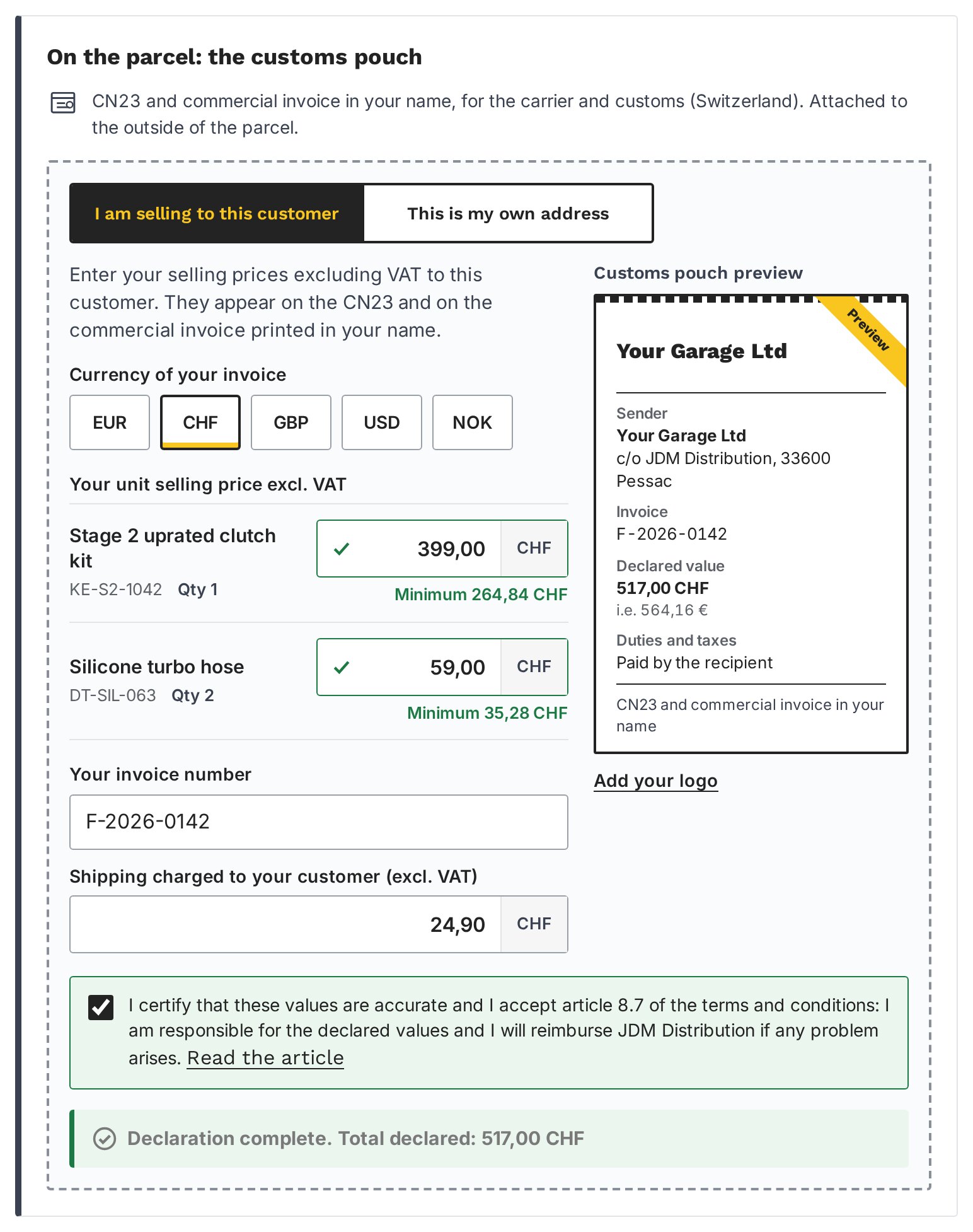
A preview of the pouch updates as you type. You tick the box certifying your values, and you are done. We generate the CN23 and the commercial invoice in your name, with your company name, address, VAT number and logo. The parcel leaves with your name as the sender, and any returns come back to our warehouse.
Add your logo once and for all in your My brand for shipments area. Is the parcel going to your own address, for example your shop in Réunion? Choose “This is my own address”: we then declare our own prices, in the name of JDM Distribution.
Declaring the right value
The value to declare is what your customer pays you, excluding VAT. Never a token value, never “gift” for a sale. Customs know these practices, and an undervalued parcel may be held and end up costing far more than it earned.
For each item, the form shows a minimum: the price you paid us for it. A selling price below your purchase price would raise questions, so it is refused. Above it, the price turns green.
Customs codes and countries of origin are already filled in on our product pages, so there is nothing to look up. By ticking the certification box, you take responsibility for the declared values.
Above €1,000, your EORI number
For a shipment worth more than €1,000 outside the European Union, the carrier files an export declaration in your name. It needs your EORI number, the customs identifier for businesses. You can request it free of charge from your customs authority, and it starts with your country code. You enter it once, and it is kept for your next shipments.
Duties and taxes: who pays?
Our shipments go out under DAP terms: the recipient pays import duties and taxes on delivery, often with a handling fee from the carrier. Let your customer know before shipping. A customer who knows pays without surprise, a surprised customer sometimes refuses the parcel.
And inside the parcel?
The customs pouch is attached to the outside. Inside, you can slip in your own invoice or delivery note, just like for your shipments within the EU. Everything is explained in our article on your documents in the parcel.
Frequently asked questions
What is a CN23?
It is the customs declaration for a parcel sent outside the EU VAT area. It describes the contents, value and origin of each item.
Do I need a CN23 to send a parcel to the French overseas departments?
Yes. They are outside the EU VAT area: a parcel to Guadeloupe, Martinique, French Guiana, Réunion or Mayotte travels with a CN23.
What value should I declare on a CN23 when dropshipping?
The selling price excluding VAT paid by your customer, never a token value. With us, it cannot be lower than the price you paid for the item.
Do I need an EORI number to ship outside the European Union?
For a shipment worth more than €1,000 outside the European Union, yes. Below that, we do not ask for it.
Sell everywhere, we handle the paperwork
The service is included in every trade account at no extra cost. Not a customer yet? Registration is free and reserved for automotive and e-commerce professionals.
Share this content